My grandfather was a colonel who fought in 1924 and 1932. The 1924 civil war was Honduras's bloodiest with estimates of up to 3,000 deaths or around 4% of the Honduran population at the time, which would make it roughly equivalent to the current war in Gaza in terms of loss of life and destruction. He was barely 13 when he joined the troops in the previous war, which was just as bloody. An old photo shows him in uniform, a revolver on the side of a leather belt with bullets all across, the face almost completely erased by the passage of time and poor keeping. I only know it from a digital copy that one of my oldest cousins circulated — a ghost in uniform, staring out of a time never lived through, but that somehow still shaped my life.
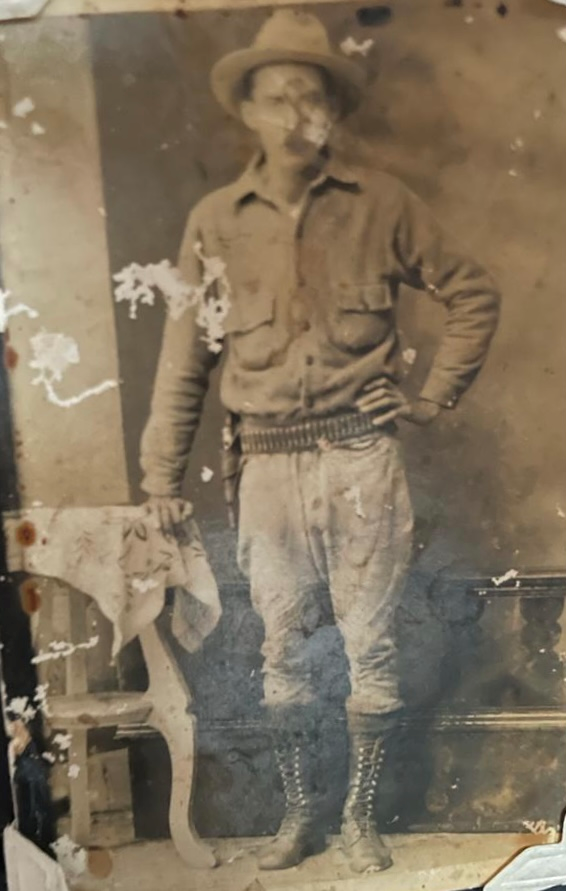
He was born in 1907 during yet another civil war, this time with the intervention of El Salvador and Nicaragua, that had left another 1,000 to 1,500 dead and thousands more wounded. He would live through another uprising in 1911 before he finally ran away to join the troops during the 1919 revolution, tending after the horse of his uncle — a colonel, who tried to keep him out of harm's way, until he became a fully-fledged soldier by 1924 and quickly rose through the ranks, becoming a Major by the time he served during the 1932 revolt and later reaching the rank of colonel.
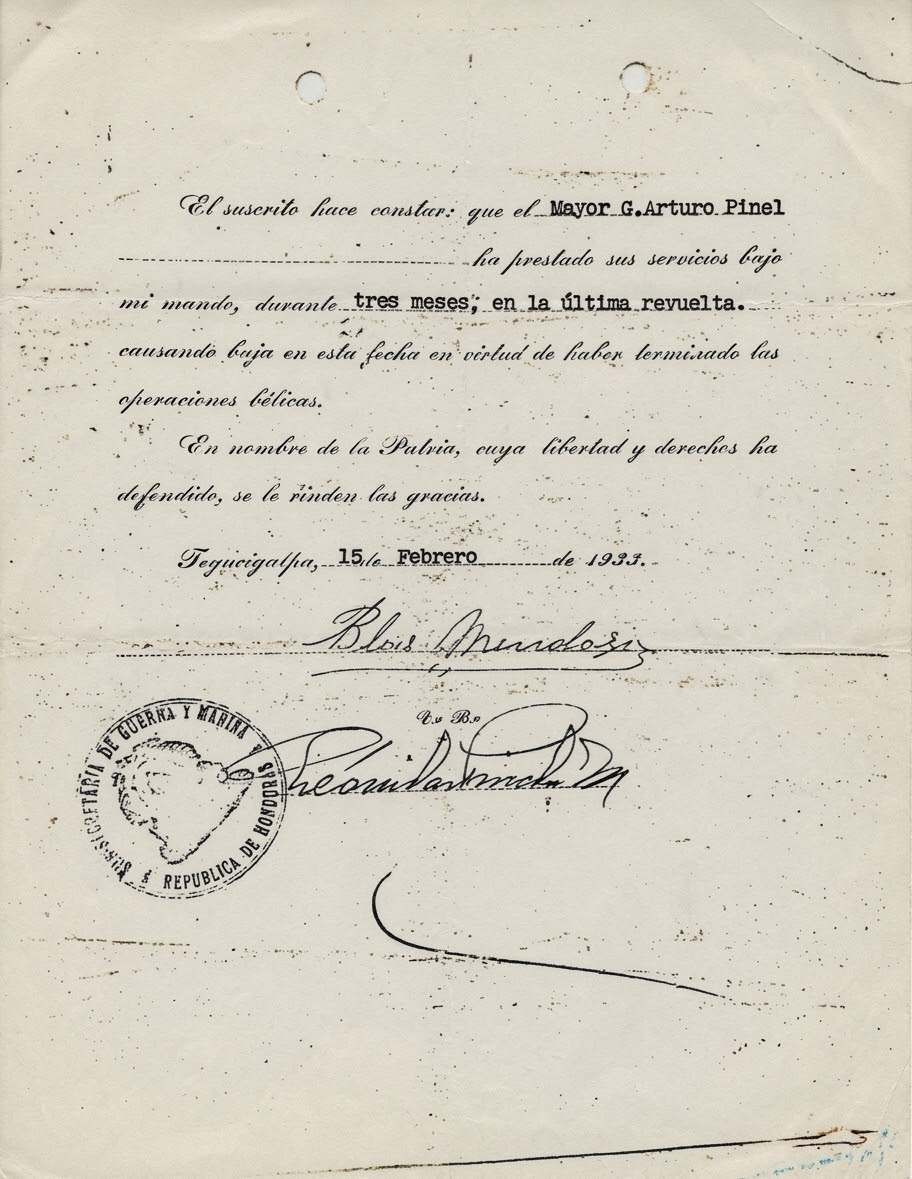
Before his death in 1974 he would live through the 1954 coup, the attempted revolt by Colonel Armando Velásquez Cerrato in 1959. Back then — my mother says — dozens of men who had served under him showed up at his doorstep to ask him to fight again under Cerrato, but he refused and told them to go back home and wait, that he would call for them if the time ever came. The time never came and they never came back.
Then came the 1963 and 1972 coups. His life had been marked by conflict, instability and bloodshed, yet he kept a stable marriage and raised 8 children of which only three women survive, including my mother.
He died in 1974, when I was barely three years old. I barely knew him. A few fleeting memories, mostly in the form of images, still come every now and then — his blue eyed smile while sitting beside him on his blue pickup truck, while he received the dairy products from the farm he had dedicated his civilian life to after he took off the uniform, him pouring milk straight from the cow onto a glass that he would then hand me over — but I have been thinking about him a lot lately, because his life is an almost perfect map of the Honduran history of instability — and I have come to believe that history explains more about why Honduras remains stuck than any economic model or policy prescription ever could.
Between 1821 and 1982, Honduras saw armed conflict of some kind or another in 71 of 162 years, about 44 per cent of the time. Strip out massacres and foreign incursions, and Honduras was still in the middle of a civil war, revolt or coup every 3.5 years on average. Nobody growing up in that country could assume the rules would survive the army marching on the town. How do you plan for the next harvest when it might get seized or burned by marching soldiers at any time, let alone create a business plan? People hedged: they took their returns early, kept a friend in every camp, and flipped the portrait on the wall when the new general arrived. It was sensible behaviour, which after a while hardened into habit, and habit eventually becomes culture. A country that has never been able to assume its rules will survive the army marching on the town cannot develop the long time horizons that growth requires. Investment needs predictability. Trust needs continuity. Neither survives a coup or a civil war every three and a half years.
Plans written in one government become worth less than the paper once the next arrives, which is why none of the long-term strategies Honduras has drawn up has outlived its authors. As an adult I have lived through "the new agenda" — which people joke was so new that it was empty — the "poverty reduction strategy", "the national plan and country vision", "plan 2020" and "the refoundation of the country". Many more had come before, but I was too young to remember any of them. I only knew that none ever made a change. What else can you expect in a country with a history like ours? Politicians, after all, are also a product of their culture, and ours are incentivized by local mentality into short terminist decisions that result, at least in part, from our historical pattern.
I once saw a Honduran flag proudly flying amongst a few others by the roadside in Seoul. When I asked why it was there, I was told that they belonged to countries that had sent aid after the war. In 1979 its president — General Park Chung-hee — was assassinated and the two that followed were eventually convicted of corruption and coup-related charges. Still its economy kept growing. Its products turned from what we considered cheap knock-offs when I was a kid to leading high-tech brands that everybody wants to own. Politics and instability didn't matter much because every successor stuck to the plan come rain or fire.
Singapore clawed its way out of poverty through sheer discipline and rule of law, turning a backwater swamp into a global hub for finance, logistics and technology. Dubai turned its sand dunes into an oasis for finance and logistics in the middle of the world's most unstable region. Today either place moves more shipping tonnage on its own than the entire eastern seaboard of the United States.
Meanwhile, Honduras's best ten-year average is about 5.5 per cent, and it has never held 5 per cent for more than five years running. More often it grows at a measly 1 to 3 percent, if at all, only to see the gains often disappear with the next hurricane or drought, never able to develop any kind of industry beyond very simple textiles or light manufacturing.
Somebody once said that history doesn't repeat itself, though it often rhymes. Honduran culture is, at least in part, the result of its tumultuous history. Endless cycles of instability are bound to produce the kind of mistrust and short-termist mentality that translates to our current results, but Dubai, South Korea, Singapore and many others show that history and culture aren't destiny, and that even if they were, destiny can be changed.
My grandfather's Honduras isn't the same as mine, and mine certainly won't be the same as my children's. Though he would speak to my mother about his military service every now and then, my grandfather rarely spoke about the wars themselves. Perhaps that silence was his way of trying to give his children something he had never had: a life that didn't require knowing which side to be on. He mostly succeeded. He was a part of the history that created the Honduras that we inherited, a history where a thirteen-year-old doesn't run away from home to join the marching troops — and one I have chosen to at least try to change, to build the kind of country where nobody has to flip the portrait on the wall again, and I often wonder what he would think of that fight.
Leave a comment