Anybody who met me as a teen would not have figured me out as a lawyer. I only went to law school because studying film or literature at the time could not be done in Honduras, and even if I had done it in another country, it would have most likely been a recipe for a life of poverty and frustration—a fact that my father wisely reminded me of when I was choosing a profession. I made the decision to go to law school based on two criteria: I had friends going there, so I would not be alone, and I had been told that it was a place where I could meet pretty girls. This last part turned out to be true as that is where I met my wife.
Law school was mostly a boring affair for me. Classes seemed repetitive and exams were based on memorization, something that I have always found hard when the subject is dry. Mostly though, I was a young man who liked to ask questions, curious about the world and who would not take an answer if it didn't make sense, even if it came from a professor.
The statutes we studied often came from what seemed like ancient times. The 1906 Civil and Civil Procedure Codes, the 1950 Code of Commerce. These were taught as if they were the bible, the apex of human knowledge and perfection and they seemed as untouchable as the ten commandments.
Because this was a national university based on the Latin American model where authorities are elected by students, we had to eventually undergo an election for the dean of law school, and the student representatives and professors started campaigning. One of the candidates hung a big list he called his "Decalogue", advice he said, that future lawyers should follow. The first one read "Do not try to invent anything, everything is already written." A basic ode to the ossification of knowledge and creativity. It is a wonder that a mind like mine, bound on reforming systems, changing governance and incentives, survived almost intact. Only my rebellious nature, natural curiosity and the fact that I often paid less attention to what was said in class than to the questions that had been circling my mind since I had come back from my year as an exchange student kept me sane throughout those years.
A few weeks ago while driving into the city from my house, I listened to an interview with a man called Dan Wang about his book called Breakneck: China's Quest to Engineer the Future, published by W. W. Norton in 2025. I have not yet read the book—it is on my ever-growing pending reading list which my wife says needs a bigger house—but from the podcast I gathered that its main contention is that China is an "engineering state" focused on building and mobilizing resources, while the United States has become a "lawyerly society" focused on rules, procedures, and obstruction.
Listening to Mr. Wang's contention, I was reminded of something that I quickly found thanks to the miracle of artificial intelligence. In 1994 the Christian Science Monitor published an article called "Do Too Many Lawyers Spoil the Economy?"
The piece centred around Stephen Magee, then a finance and economics professor at the University of Texas at Austin, who plotted lawyer populations against economic growth rates across countries and produced what became known as the "Magee curve." His claim was that lawyers bring economic benefits up to an optimal point, but that beyond it lawyers engage in rent-seeking behaviour and their effect turns negative. By his calculation, the United States had about 40 percent more lawyers than that optimum, with each "excess" lawyer knocking roughly $1 million off US GDP annually—later popularly quoted as "for every 1% increase in lawyers, economic growth falls roughly 3%."
The first time I read this article, after a friend from law school sent it to me as a joke, I laughed then dismissed it quickly as some kind of funny statistic — the same way I always laugh at lawyer jokes then file them in the sarcastic part of my brain for later use as needed. Reading it again now, though, I could not help but whiff that there might be a hint of truth to it.
Professor Magee's contention has not gone unchallenged. The article itself cites at least two critics at the time — Charles Epp, a political scientist and fellow at the Institute for Legal Studies, and Frank Cross, an assistant professor of business regulation at the University of Texas, both of whom criticised Magee's methodology and conclusions. Other studies, though, have arrived at a similar place. Kevin Murphy, Andrei Shleifer, and Robert Vishny's widely cited "The Allocation of Talent: Implications for Growth" argues that when a society's most talented people are pulled toward rent-seeking professions like law rather than productive ones like engineering or science, growth suffers.
Nonetheless — I thought — maybe this idea could partially explain why reform is so hard to execute in Honduras. After all, in my experience, it is always lawyers that come up with all kinds of reasons why something cannot be done, usually to protect their own rent-seeking behaviours, despite reality and economics often saying otherwise. Instead of just ruminating about it, I did what I usually do when a statistic intrigues me: I started gathering some data and crunching some rough numbers.
Anytime a new lawyer registers in the Honduran Bar, they receive an identification number that is purely sequential. My number is 6,289, which means I was the 6,289th lawyer to register as a member of the bar. According to the numbers assigned to recent graduates there are now over 45,000 lawyers registered in Honduras. Now let's assume that about a third of them are dead, retired or simply do not practice. That leaves us with 30,000 practicing lawyers. Using the current population estimate of 11.2 million, dividing 30,000 ÷ 11,200,000 gives us roughly 1 lawyer per 373 people — about 0.27% of the population.
Compare that to Singapore, which became one of the world's wealthiest nations through rule of law and efficiency while Honduras remained stagnated. According to the Law Society of Singapore's most recent count there are 7,429 registered lawyers in the country, serving a population of about 6.11 million. That gives Singapore 1 lawyer per 823 people — about 0.12% of Singaporeans are lawyers.
Honduras has 2.5 times as many lawyers per capita as Singapore. Though correlation isn't causation, one can't help but wonder at the different results.
Years ago, when I was trying to explain the need for a special jurisdiction managed by common law judges following the Dubai model, I used this chart to illustrate it:
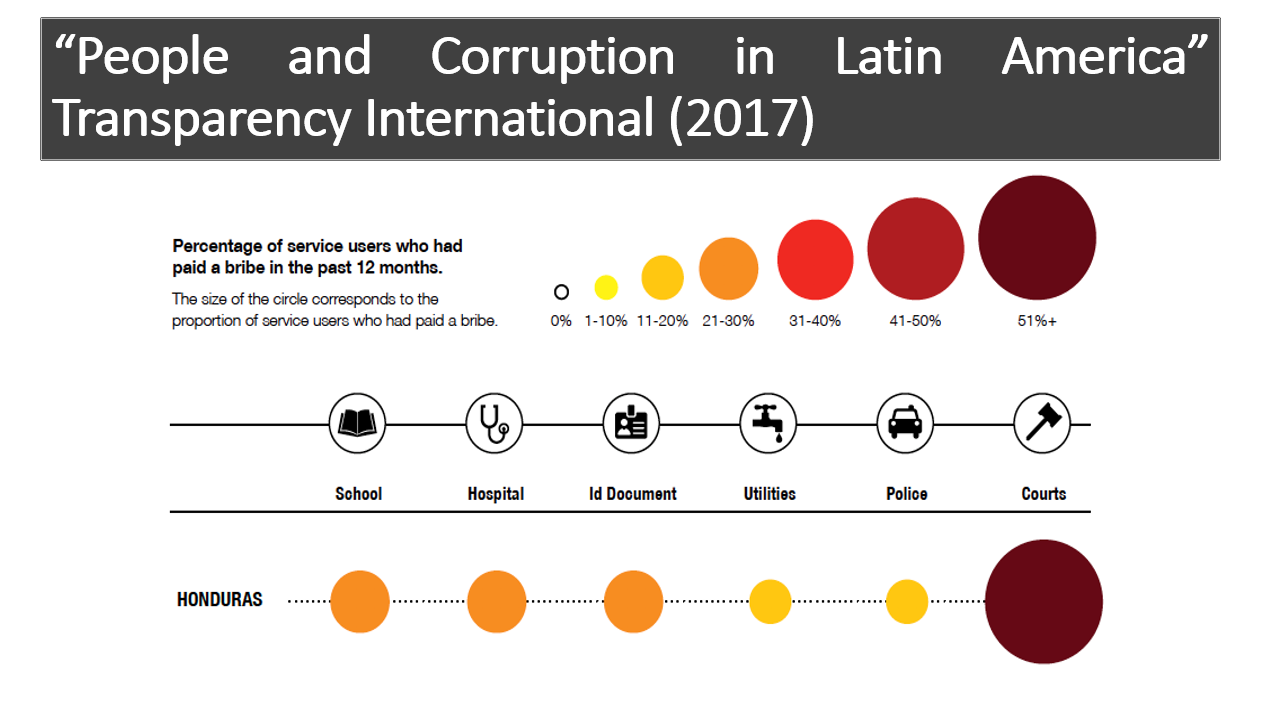
The chart always reminded me of a friend who once told me that he stopped litigating because whenever he didn't get a message from the judge requesting a bribe, he'd get worried that the other party had already paid him off. The sad truth is that such a grim statistic has a terrible effect on rule of law and, consequently, on economic growth.
Yet another question lingered. How come with so many lawyers we still fail to build a proper legal system? There are several reasons that could help explain it: deficient legal education, political capture of the judiciary. But none of these should happen if enough lawyers were willing to defend the principles of rule of law on which prosperous societies like Singapore are based. Certainly one of the reasons must be that the number of registered lawyers in Honduras has grown around 600% since I became one about thirty years ago. All of those lawyers are fighting over the same piece of pie and trying to justify their existence and rent-seeking behaviour through laws and regulations that they themselves proceed to break, because when doing anything is hard, corruption becomes the norm.
All of that memorization required in law school creates a caste that knows the law by heart but has not internalized the core principles on which it is based: respect for life, liberty and property, human rights and dignity are concepts that get repeated but are not properly understood, so they are not strongly defended. Changing that requires critical thinking, which is not taught in law schools in Honduras and throughout most of Latin America. I was fortunate enough to continue my education in some of the world's leading universities and learned to appreciate the difference. I even tried to teach it when I briefly became a professor — with mixed results, I would say, at best.
When I was in Australia and told people that I was going into law school they were always impressed. Becoming an Australian lawyer is proof that you are amongst the best and brightest. In Latin America, and certainly in Honduras, it is mostly taken as evidence that you are bad at math. Throughout my many travels I have found that this pattern gets repeated in almost the same way throughout most developing nations. Perhaps stricter regulation of the legal profession through a properly imposed bar exam and periodic revalidation is necessary to overcome these deficiencies. I am certain that if international organizations really care about rule of law, they have to start investing in improving the quality of legal education and making sure that lawyers understand the kind of power they are given to create the kind of nation we should aspire to: a nation of laws, not of men.
For years my friend Octavio and I have joked that Honduras is not a developed nation because lawyers say it would be illegal to become one. I now wonder if perhaps there is some truth to it.
Leave a comment