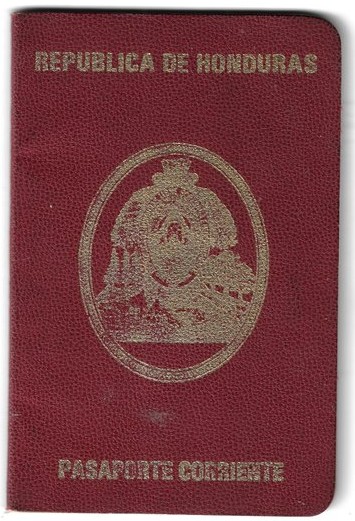
After writing about my old passport, I asked my mother to send it to me so I could scan the page with prohibition—the list of banned countries I mentioned. My purpose was twofold: I wanted to keep it before it faded further, and I also wanted to add the photo to the original essay and share with you. My reader. She then sheepishly admitted that she had torn the page to keep the photo of me as a boy. The passport had been incomplete ever since.
Instead she sent me my second one, issued a few years later, still complete except for the prohibition, which had since been removed from official documents. The photo in it shows a teenager in a red shirt close to turning eighteen years old, full of life and curiosity. Signs of a proper 1980s attempt at a mullet can be seen on the back of the head, worn with rock and roll ambition and without a hint of irony. The kid in the photo has no idea yet where his life is headed, nor that the trip for which the passport was obtained would be the beginning of a lifelong journey that was about to begin.
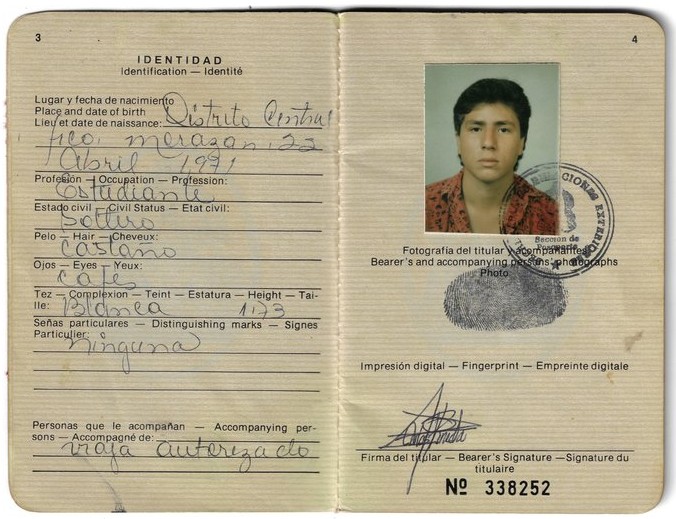
A few pages later, an Australian student visa marks the starting point of what is to become the rest of his life.
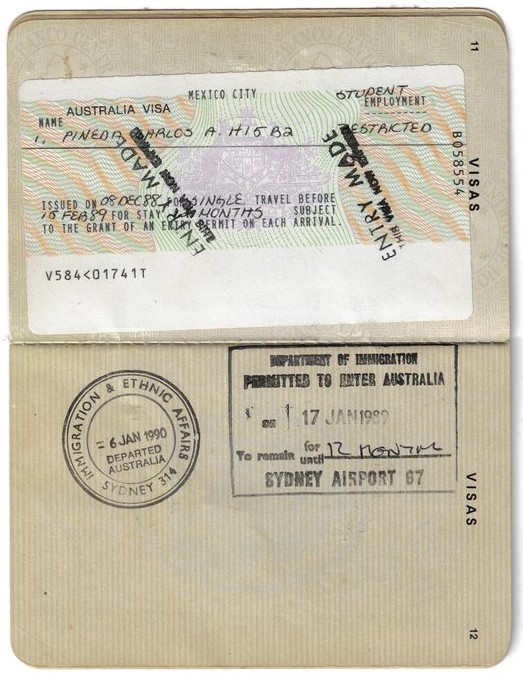
I spent 1989 living with the Robertsons — a kind, generous family patient with a kid from a culture almost completely alien to them who understood perhaps half of what they said to him for at least the first few weeks. Though John, my host father, passed away a few years ago, I am still in touch with my host mother Eleanor, and my host siblings, which should tell you something about who they are. I made friends that year from more countries than I could recite by heart, all exchange students like me, thrown together into orientation camps and a shared once in a lifetime experience, developing the particular kind of intimacy derived from trying to play it tough while being homesick at the same time. One of them—a Chilean—remains one of my best friends to this day.
But the most important thing I came out with from that year was something else. A nagging question about why some countries could build a proper future for their people while others, like mine, could not and an appreciation for different cultures and approaches to solving problems. Learning to understand the difference between how an Australian and a Singaporean think and process information and communicate, and how that is different from a Swede or a Brazilian became a skill that would serve me well in my future work as a negotiator.
Australia was a talent magnet. Honduras seemed like the exact opposite — a country willing to expel its best and brightest citizens to use their talents anywhere but home.
Australia was back then—and still is now—a talent magnet. People arrived from all over the world seeking opportunities that simply didn't exist wherever they came from. Honduras instead seemed like the exact opposite, an exporter of people. A country willing to expel its best and brightest citizens to use their talents anywhere but home. I did not understand back then much about institutions, rule of law or concepts like credible commitment, nor did I know how many more stamps in many different passports I would collect trying to figure it out. That knowledge would come much later, along with the education and the often bruising experience needed to use them properly. I only knew that while Australia offered a shot at success, Honduras did not. I also knew in the uninformed way that a kid about to turn eighteen does that it was not about the people. That the average Australian was not smarter nor much different from the average Honduran. That the way that both countries were governed somehow made an enormous difference.
Years would pass before I could explain what I had sensed, but that year in Australia was where the seed of that question took root, long before I had any idea what shape the answer would take.
Almost twenty years to the date when I first landed on Australian soil, my friend Octavio Sánchez sat across from me, talking about something that he called "free commerce zones" as a way to provide areas where Honduras could retain talent instead of expelling it. I didn't quite understand the significance of that conversation back then, nor how much of the rest of my life would be consumed by that idea and its implementation. But looking back I understand now why, despite not fully understanding it, the idea found such fertile soil in the mind of that kid with a mullet, now turned into an adult. Octavio had, unknowingly, handed me a possible answer to the question that had been nagging me since I was eighteen.
Whether the answer we built was the right one is a story that I tell at greater length elsewhere. All I can say is that the search for it began, as these things often do, with a teenager who did not quite understand what he was looking at but who could tell the difference, and that somewhere, people were building something better than what his own country had not learned how to build, and that he would eventually try to understand and help build it himself.
Leave a comment